


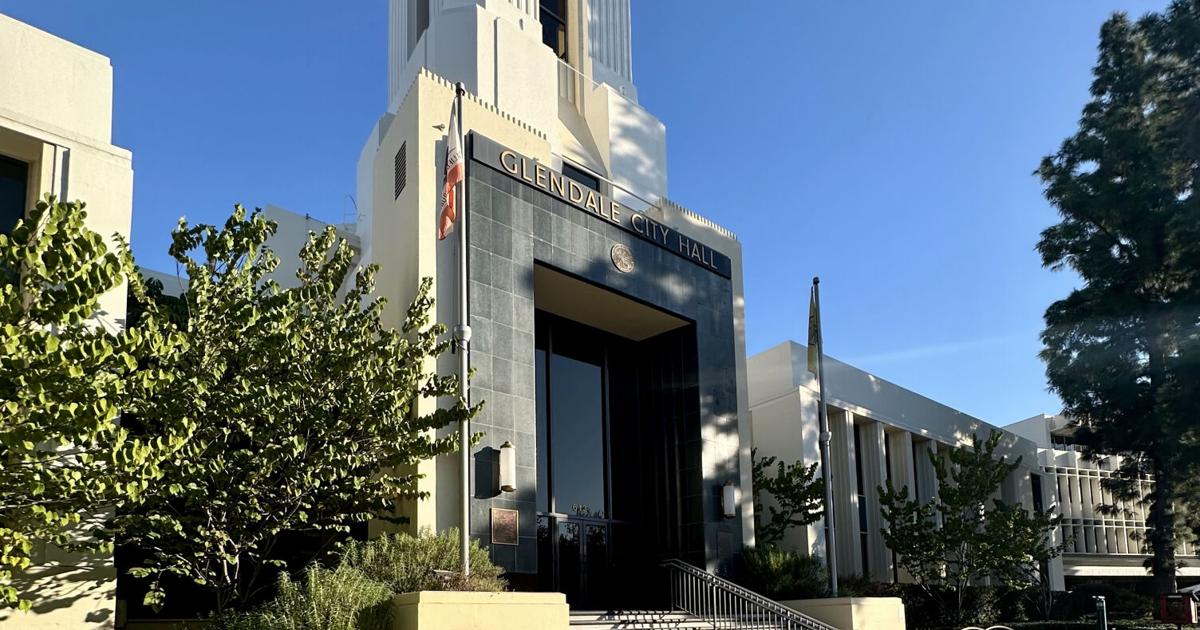
A recent review of two financial reports by the Glendale City Council shed concern on the city’s ongoing fiscal health amid economic uncertainty, with one official saying there was “no good news.”
Jack Liang, Glendale’s director of finance, provided the council and public with an overview of the city’s financial position on Dec. 9, with key updates including a summary of year-end financial results for fiscal year 2024-25, the city’s financial performance through the first quarter of FY 2025-26, an updated five-year general fund forecast and report on the progress to date on revenue initiatives that are currently under consideration.
Human Resources Director Paula Adams also provided an update on minor amendments to the city’s classification and compensation structure.
“No good news, really. There’s a lot of slowing down, a lot of concerns. Not too bad of a news. We’re not seeing a sharp drop in our economy yet,” Liang said. “So it’s mixed and uncertain. I would say that the takeaway from this economic information is that we should be cautious as a local government, as we thrive on stability as well as service delivery, the uncertain economic factors actually does affect us, and my team pay close attention to it, and that actually fits into some of the assumptions that will walk you through your future financial forecast,” Liang said.
At the meeting, councilmembers discussed strategies to address the fiscal concerns and manage costs, including through deferred maintenance, salary freezes, increased revenue generation, a review of the city’s pension obligations and the potential for an infrastructure bond.
Public commenters also expressed their concerns about Glendale’s fiscal health, while suggesting measures to help improve it in future years.
ANNUAL COMPREHENSIVE FINANCIAL REPORT
For FY 2024-25, Shu-Jun Li, the city’s assistant director of finance, said Glendale received three reports from its external auditor, CliftonLarsonAllen LLP — an opinion letter, report on internal control over financial reporting and communication with city leadership. Li said CliftonLarsonAllen issued an unmodified opinion, clean audit for Glendale’s FY 2024-25 annual comprehensive financial report (ACFR), covering July 1, 2024 through June 31, 2025.
Currently, Li said Glendale has more than 70 finance funds.
Glendale’s financial position focuses on government activities and business-type activities. Government activities include the city’s general fund, special revenue fund, debt service fund and capital improvement funds, which are mainly funded through taxes, fees and grants. Business-type activities include enterprise funds and internal service funds.
As of June 30, Li said Glendale’s net position is $1.9 billion.
According to the city’s FY 2024-25 ACFR Statement of Activities, which Li said is like the income statements of all the city’s funds, Glendale saw an increase of $104 million in its net position.
According to data from Glendale’s consultant HDL, Liang said for the second quarter of 2025 the city experienced a negative 5.5% trend (decline) on its sales tax revenue. The county overall, Liang said, experienced a 1.1% decline and the state overall experienced a 0.5% increase.
“Basically the county is doing worse compared to the state average, and Glendale is doing worse compared to the county average,” Liang said.
He added that Glendale is heavily dependent on its auto industry for sales tax revenue, a sector which saw a 12% decline in the second quarter 2025 compared to second quarter 2024.
Along with auto and transportation, the city’s business and industry, and fuel and service stations sectors retracted quite a bit, Liang said.
“Business and industry actually is one sector that grew at the state level, and that includes warehousing, business equipment, a lot of the business-related industries. But for Glendale, we actually took a different direction.”
Some of the city sectors, Liang said, experienced sales tax revenue growth, including general consumer goods, restaurant and hotels, food and drugs, building and construction, as well as the county and state pools.
Liang said Glendale went from a 5.7% increase in property tax revenue in FY 2023 to a 4.2% valuation increase in 2025-26.
“We’re still growing our valuation from a real estate property perspective, but the trend is definitely slowing down at the same time,” Liang said.
Although the county is experiencing a “slowing down trend,” Liang said its net taxable value growth for property taxes has stayed above Glendale’s level.
“That tells us that our development, our value increase, is slower comparatively to the other areas in the county,” Liang said.
YEAR-END FINANCIAL RESULTS
Budget Manager Karina Cervantes said Glendale ended FY 2024-25 with $341.3 million in actuals, a $28.9 million increase compared to FY 2023-24.
Cervantes said the largest revenue categories within the general fund are property and sales taxes, with each contributing about 25% of total general fund revenues.
Glendale has been growing its property tax revenues, ending FY 2024-25 with about a 7.4% increase compared to FY 2023-24. However, sales tax has seen a decline, Cervantes said, due to an economic slowdown and a “market correction” following several years of consistent growth.
In 2022-23 actuals for sales taxes were $92.5 million, with $78.7 million received in the general fund and about $14 million received in the Capital Improvement Program Fund (CIP) for various projects. In 2023-24, Cervantes said Glendale saw a drop of $6.5 million, but saw no changes in 2024-25.
However, Cervantes said Glendale did experience growth in other categories such as utility users taxes, which increased by about $4.1 million, due to an increase in electric rates and elevated consumption.
In charges for services and license permits, Glendale also sees growth, which Cervantes said is partly due to the comprehensive citywide fee study that was conducted prior to FY 2024-25, which updated service cost for fees. For the sector, Glendale saw an increase of about $1.7 million, due to planning and building permits revenue going up.
In the interest and use of money category, Cervantes said the city sees more fluctuations. The regular revenue in this category is about $3 million for interest income and about $1 million for rental income.
In transfers from other funds, Cervantes said Glendale saw an increase of about $8.9 million, $5.5 of which is due to the Glendale Water and Power electric transfer.
“So although we maintain the transfer percentage at 10% because electric rates did go up, the base became larger, which led to a higher transfer amount,” Cervantes said.
The remaining $3.5 million, Cervantes said, is due to the collapse of the city’s parking fund, which closed in June 2025, with any remaining fund balance being transferred to the general fund, and “will ultimately be used for operational costs that shifted to the general fund as a result of the fund closure.”
For FY 2024-25, the $341.3 million total revenue figure reflects a collection rate of about 102.8%, which means Glendale’s is slightly over its original revenue projection presented during the study session.
Cervantes said Glendale ended FY 2024-25 with about $330 million in expenditures, which reflects an increase of around $9 million compared to FY 2023-24, with the biggest increase being in the salaries and benefits category which grew about $25.7 million, and is the result of cost of living adjustments, normal step progressions, and a higher number of filled salary positions.
Glendale ended FY 2024-25 with about 45 more filled positions than FY 2023-24, and higher wages that trickled down to higher benefit costs.
For maintenance and operations, Glendale saw a decrease of about $2.2 million, due to a $2 million decrease in direct assistance from the winding down of the monthly housing rental subsidy program that ended in FY 2024-25.
The transfers to other funds category saw a decrease of about $14.9 million because in 2023-24, the city was projecting a surplus of about $10 million, and ended up transferring that amount to the CIF for the Central Park project, a one-time transfer that did not reoccur in 2024-25, which accounts for the large decrease.
Overall, Cervantes said Glendale ended FY 2024-25 with $330 million in expenditures, which reflects expenditure utilization of about 98.3%, keeping in mind this reflects $8.6 million in budget balancing strategies, reduction of expenses and costs that were implemented in FY 2024-25.
“Once we factor in all of the revenues received and the expenditures, we ended the fiscal year with $134.6 million in budgetary fund balance, which is about 41.3% reserve percentage. So although the current policy is a minimum of 25% and a target of 35% this exceeds that, but we do see that trend going down,” Cervantes said.
Liang said the city’s expenditure rate went from 96% to 95%, then 98%, which he said operationally is “fantastic” because they’re filling more positions and providing more services, but financially it has created challenges.
FIRST QUARTER FINANCIAL RESULTS
According to the FY 2025-26 first quarter financial results through Sept. 30, Cervantes said Glendale has collected 10.8% of the city’s projected revenues, at a near $37.7 million.
“That’s very common at this time of the year, as some of the revenues that are received in July and August get accrued back to the prior fiscal year, and also it’s due to timing,” Cervantes said.
The expenditure side, Cervantes said, follows a “more normal pattern,” with a 22% utilization rate and total expenditures at $78.1 million.
“As long as we’re at or below the 25% mark by Sept. 30, that means that we’re on track,” Cervantes said, adding that all of the city’s departments are at or below the 25% mark.
Liang said the general fund forecast is composed with a “simple formula,” starting with the city’s “prior period results” for FY 2024-25, combined with its projected revenues minus projected expenditures.
Assumptions for the general fund forecast, Liang said, are based on historical trends, the current economic environment, budget balancing strategies, operational conditions and factors and expert analysis from consultants.
“On the property tax and sales tax side, operational conditions and factors that we’re a little more in control in those areas where we can actually keep our costs down, we can kind of delay certain spendings,” Liang said. “Some of those assumptions, as you can see, are a little more in control to our management.
“Some of those assumptions are a little less in control or subject to external factors. So all of those, my team and myself continue to monitor those and continue to update our assumptions.”
Major revenue assumptions, for Glendale’s General Fund Forecast as of December 2025, on the revenue side include four tax categories, property tax, sales tax, utility user tax, occupancy tax, and property tax.
For FY 2025-26 property tax revenue assumptions, Glendale is expecting a 4% increase and a 2.4% increase for 2026-27, “a slower growth rate,” with a 3.5% increase for fiscal years, 2027-28, 2028-29 and 2029-30.
For sales tax, Liang said Glendale is fully expecting a decline for 2025-26, a negative 2.4%, with a rebound of 2.1% for 2026-27, getting back to a “normal” of 2.7% in 2028-29 and 2.9% increase in future years.
For utility users tax, a 3.8% increase is projected in 2025-26 and negative 0.6% in 2026-27, with a “moderate rebound” in future years.
For occupancy tax, there is a 4.3% surge in 2025-26 and 9.6% in 2026-27 because Glendale is anticipating the opening of a new hotel in 2026-27. In the following years, Liang said Glendale goes back to normal growth rates.
“A major factor of our assumptions is we’re assuming a revenue collection rate of 100% meaning everything that we budgeted for, we’re going to be able to collect, and our historical trend has been supporting that,” Liang said.
For major expenditure assumptions, the city looks at its salary and benefits, through a detailed analysis, Liang said.
For expenditures, which include salaries and benefits (expenditure utilization rate), contractual services, other discretionary and M&O, transfers to CIP, transfers to other funds and maintenance and operations (expenditure utilization rate), the city has made an operational assumption that it’s going to spend 98% of what it’s budgeted, which Liang said is somewhat supported by the city’s historical trend.
“As I mentioned earlier on, that data point that our trend is creeping up a little bit, so we do need to manage that carefully to make sure that we’re still meeting that 98% target expansion,” Liang said.
At the time of the council’s June 2025 budget adoption, the city was anticipating to cut into its reserve for $4.9 million in 2024-25, after an $8.6 million budget balancing strategy. However, Liang said the city’s reserve came back “slightly better than what we anticipated” for FY 2024-25, ending at $1.6 million.
For 2025-26, the city implemented $20.6 million worth of budget balancing strategies, Liang said.
Liang said Glendale’s list of revenues and cost reduction measures have been an ongoing subject of discussion among the city’s leadership, adding that Glendale’s fund balance is projected to decline in future years according to current assumptions.
“You can see that the trajectory of our expenditure growth seriously outpace our revenue trajectory based on our economy. We don’t have a whole lot of control to our revenue, but on the expenditure side, based on our current state … we’re already assuming that we’re not adding new positions in the future years, our cost is going to escalate just based on a number of factors, step increases, regular cost increases, medical cost increases, all of those will add to this cost,” Assistant City Manager John Takhtalian said.
According to current assumptions, Liang said by FY 2027-28 the city is going to be in “budget policy non compliance” and will go below the charter required level in 2029-30.
Liang the city will need to find additional revenues and/or identify cost reductions of $20 million on an annual basis, and $80 million in the next four years to end 2029-30 back in its budget policy requirement.
However, Liang said, those measures would only give the city the minimum it needs for the next four years.
“In the next four years. Essentially, that’s about $110 million in four years to bring the trend back to target, and that’s really what we need to restore financial health and financial balance,” Liang said. “I am fully confident that the city’s leadership, council will work together and figure out the best way to kind of tackle that strategy and really bring the balance back to our financial activities and, honestly, I think we’re going to land somewhere in between our minimum and our target.”
CITY’S FINANCIAL HEALTH DISCUSSION
Councilmember Vartan Gharpetian expressed concern about Glendale’s fiscal health in the future years. Gharpetian wants to generate revenues for the city without raising taxes.
“Glendale property tax is pretty good because property values hold up, but God forbid, if you have a correction, if you have something happen… wrong foreign policies, then economy goes down, and then we will be in trouble if this trend doesn’t happen for us, and this number of $20 million a year will be probably $40 million a year,” Gharpetian said.
City Manager Roubik Golanian agreed: “There are certain things we can control internally at the city government, but some we cannot.”
Councilmember Ardy Kassakhian asked what the city can do to address the long-term cost increases of deferrals of maintenance and other projects, adding he would rather spend more now so the city can take it off the books to prevent long-term impacts.
Golanian said the council and city staff will start discussing such topics during the kickoff meeting for the 2026-27 budget review process.
Kassakhian said Glendale’s budget needs “real discipline.” He expressed concerns about where the city’s sales tax revenue will go in future years due to the increase in online shopping.
“We don’t know what it is now, but even with that, this is not an idyllic picture,” Kassakhian said. “We can’t just approve things or ask for things, because we feel like it’s a passion project for us, and including myself … we have to tighten all our belts and be more restrictive in our wants versus our needs.”
He suggested looking at what the increased cost of labor is going to be, and to adopt a policy for the city that says nobody gets a raise unless the city is in the “black two years in a row.”
“That becomes an impetus and incentive for us as a council to be more realistic when we ask for things. We’ve got to partner with our labor groups, our staff, our workers, and they got to come up with ways to be in the black, but we need to police ourselves, rather than allowing us to continue to ask for new expenditures,” he said.
Mayor Ara Najarian cautioned Kassakhian and said there may be some unfair labor practices involved in regard to stopping raises, because it “isn’t fair bargaining.”
Councilmember Dan Brotman asked why Glendale’s expenses are growing faster than its revenue. Brotman said the city should revisit its pension plan deal and suggested putting an infrastructure bond on the ballot as cost saving measures for the city.
Najarian said the CalPERS Board fund managers “screwed up” the nation’s largest employee retirement fund, ignoring homegrown industries.
“In the year 2007 you could have hired a monkey to throw darts at a list of publicly traded stocks and pick those stocks that the darts hit, and we would not be in this situation where we are now, we would be fully funded,” Najarian said.
One public speaker, Herbert Milano, claimed that for many years Glendale has been balancing its budget by deferring capital improvements and questioned the significance of the city’s clean audit, budgeting practices and asked why the city’s audit committee wasn’t present for the discussion.
“What I want to say is that until you’re able to come to terms with the salary and benefits of police and fire, you won’t be able to manage to maintain a budget and maintain our CPI program,” Milano said. “A city can have properly prepared financial statements and still go bankrupt.”
Edgmund Hagopian echoed Milano’s concerns and argued that the city was shifting costs from one fund to another rather than implementing cost reductions.
Another speaker, Gustavo, who did not provide a last name, warned the council of what he alleged is a growing risk of deflation by the second quarter of 2026, as declining prices may prompt consumers to reduce or delay purchases in anticipation of even lower costs. Gustavo argued this “pullback” could weaken the local economy, placing immediate pressure on the city’s revenue structure, particularly sales taxes.
“Reduce consumer demand, shrinking profit margins and business closures could lead to a slowdown in tax revenue. However, this challenging period also offers opportunity for proactive action by planning now we can position ourselves to thrive when the economy recovers, rather than scrambling to react too late to mitigate these risks, I recommend a series of targeted initiatives to support local businesses, attract new investments and build the infrastructure needed for sustainable growth,” Gustavo said.
link